Home › For mandis
The only billing software that knows what a patti is
Written first for an APMC commission agent, not adapted to one. Loads come in on a lorry, stock sells off the floor lot by lot, and at the end the grower gets a patti with his coolie, your commission, the freight and any advance taken off it — and it prints as a proper Bill of Supply.
A mandi day, screen by screen
Four things happen between four in the morning and the evening: the lorry comes in, the floor sells, the grower is settled, and money moves both ways. Each has its own screen and they are joined up underneath.
The lorry comes in
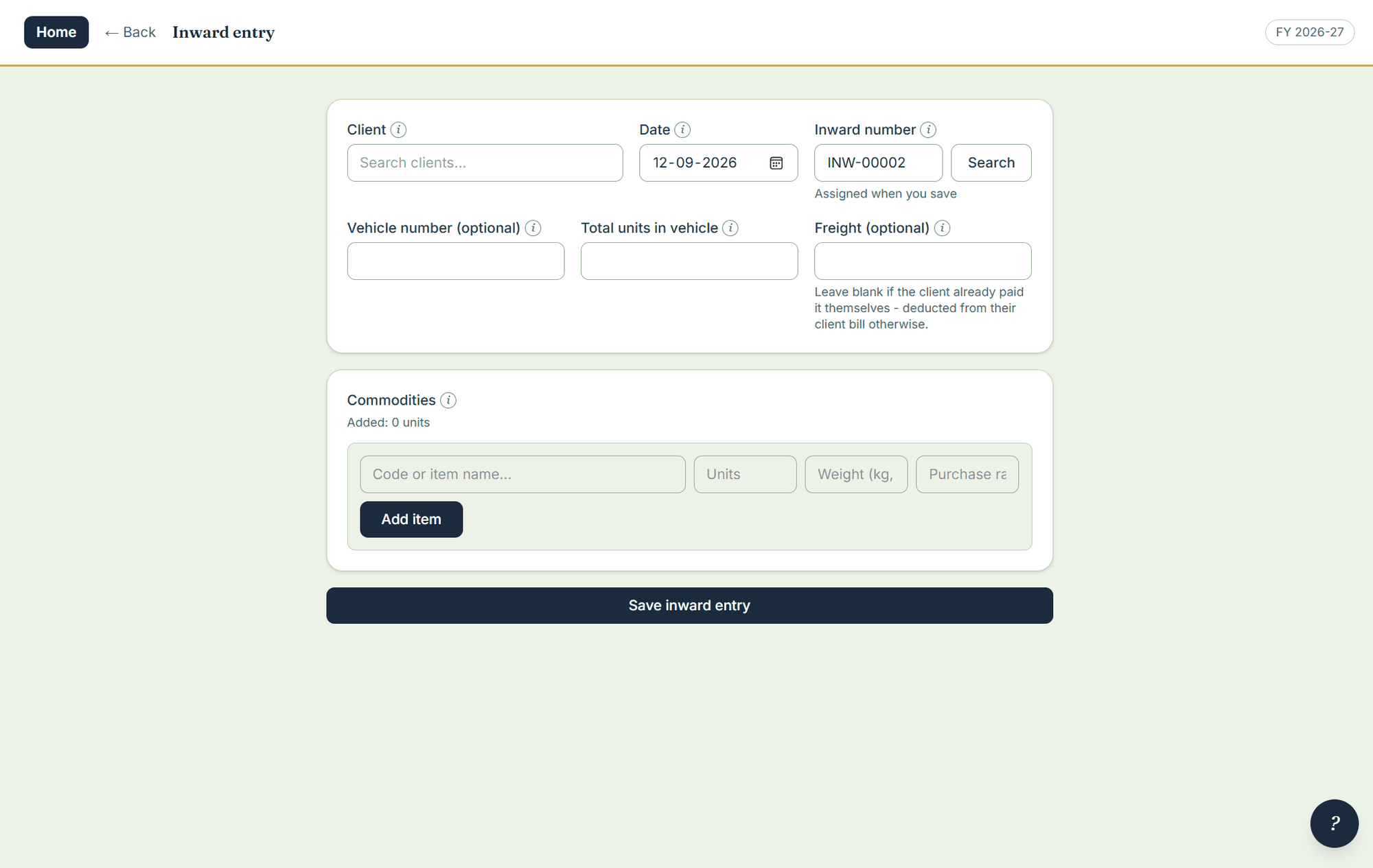
Inward entry takes the client, the date, the vehicle number, the total units in the vehicle, the freight — left blank if the grower paid it himself, deducted on his patti if you did — and the commodities with their quantities and purchase rates. It gets an inward number of its own.
The floor sells, lot by lot
The counter bills a buyer off a lot. When two growers hold the same commodity, a picker asks which lot this sale comes off. Stock already settled is never offered again, and selling more than remains on a lot is refused, not warned about. The line’s amount follows how the item is priced — by weight when a weight is entered, or by the count every time, whichever the item master says.
The grower is settled
The patti takes the gross sale and deducts coolie, your commission, the freight and any advance already paid, and shows the net owed to the client. It prints as a Bill of Supply carrying your GSTIN, the SAC for the commission and a signature line, so it stands up as a document and not only as a piece of paper.
Money moves both ways
Buyers pay you and you pay growers — two separate ledgers, each by financial year, each with its own receipts and its own ageing. The commission account shows what you actually earned across the period.
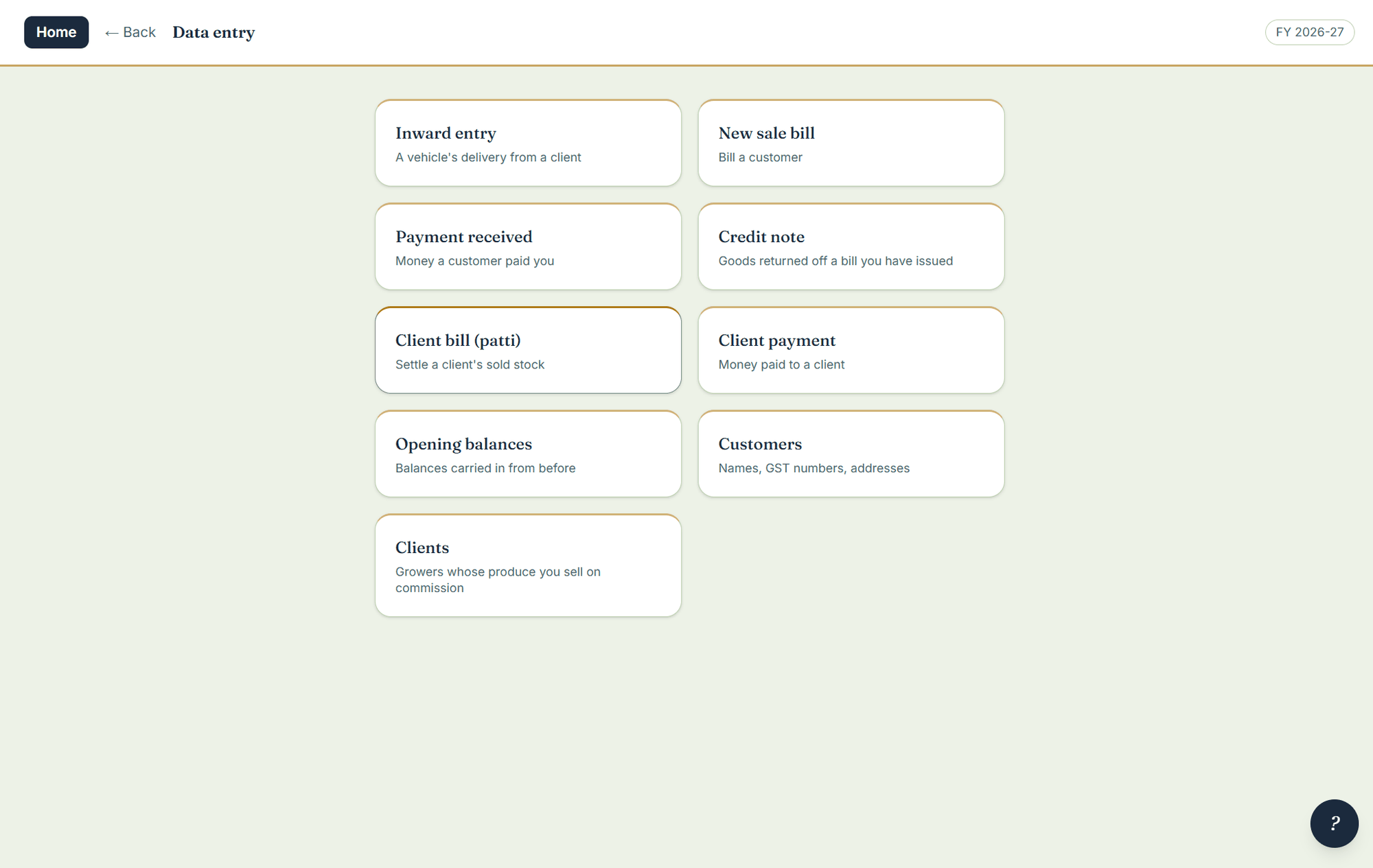
Everything an agent enters, on one screen
Advanced and Advanced Plus add the mandi half of the program: clients, inward entries and pattis take their place alongside sale bills, payments and expenses rather than being hidden in a separate module.
- Clients — the growers whose produce you sell on commission
- Inward entry per lorry, with its own numbering prefix
- Client bill (patti) to settle a client's sold stock
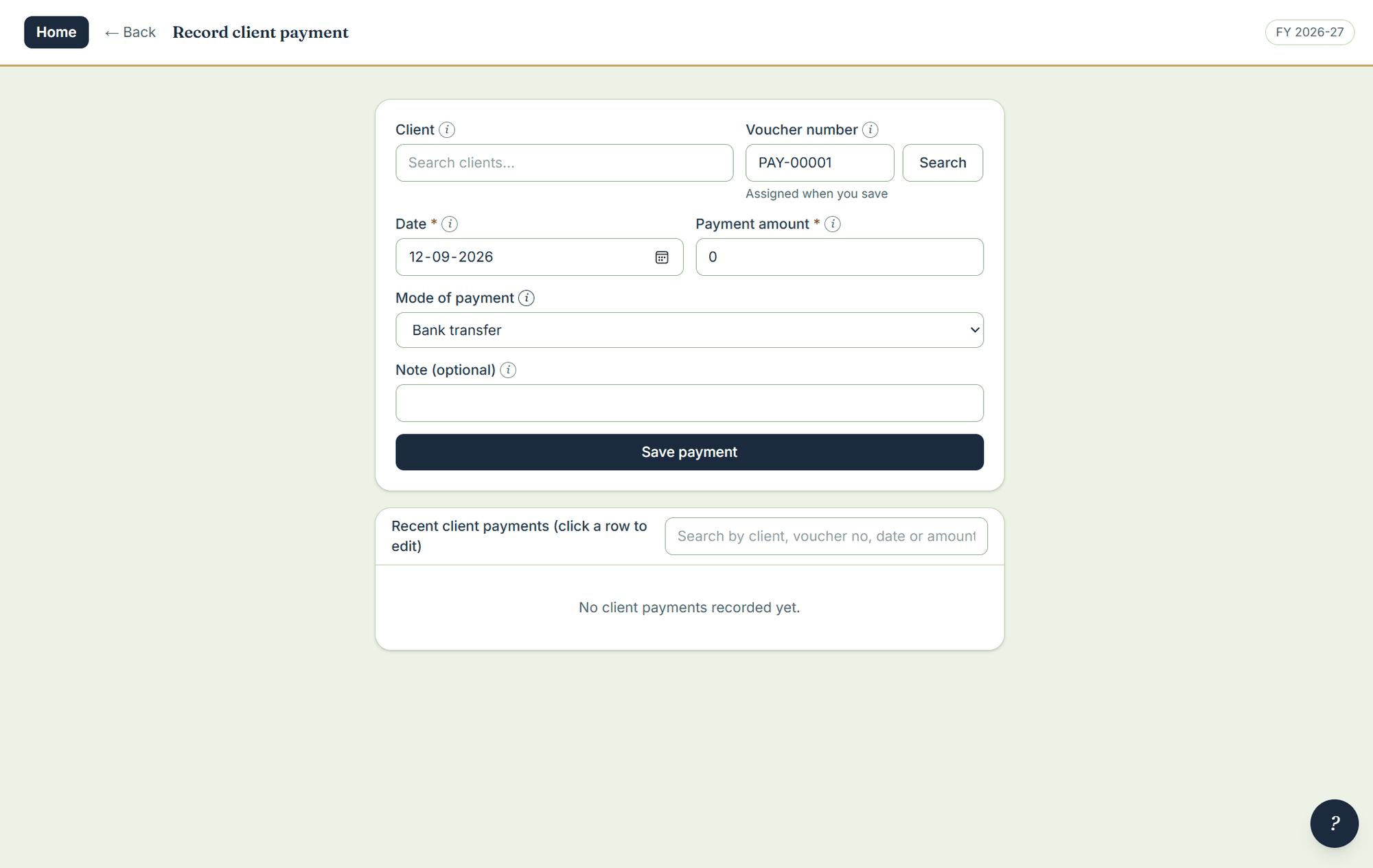
- Client payment, with a printable receipt of its own
A client ledger that matches what the grower remembers
Every client carries a ledger by financial year: what his loads made, what was deducted, what has been paid to him and what is still owed. Payments are listed under the form as you enter them, so correcting yesterday’s ₹8,344 does not mean going hunting for it.
- Client payments by cash, UPI, bank transfer or cheque, with a receipt number
- Ageing on the client side too: who is waiting, and how long
- Client bill adjustments — pattis settled above or below what the goods made
- Charges and recoveries, with coolie deliberately counted in none of it
Every load, and what is still sitting on the floor
The arrivals register lists every load by date — number, client, vehicle, commodities, what came in, what has been sold off it, what is unsold, the weight and the freight, and whether that freight has been billed. Filter to unsold only; click any row to open and correct the entry.
- Answers “what is left of Shivakumar's load?” without opening a single bill
- Freight shown against the load, and whether it has been recovered
- Commodities per load, each with its own quantity and purchase rate
- Stock on hand and item-wise sales count what was actually sold, in the unit it was sold in
Three details other software gets wrong
It is not your money
Coolie is paid on the grower’s behalf and deducted on his patti. Showing it as “recovered from clients” and adding it into a total makes your books say you earned something you did not. InBilling counts it in no report and no export at all.
Bags are counted, kilos are priced
A mandi line carries both — five bags and a hundred kilos — because one is what moved and the other is what the money was worked out from. Each item says which rule prices it, and every bill line records which rule priced it, so a reprint years later still reads right.
You did not own the goods
A commission agent’s profit is the commission earned, not the turnover that passed across the floor. The profit report opens on the commission basis, and the reports a mandi does not need — balance sheet, purchase register — stay out of the way.
Not registered under GST? Advanced is your edition, and the mandi gets the plain map it has always had: data entry, printing, purchases and expenses, items, settings — with inward, clients and client payments under data entry, and the ledgers and bills under printing. No tax screens, no returns, no portal files.
Registered, or about to be? Advanced Plus keeps every screen on this page and adds the whole of GST on top — tax invoices, the month’s return, the GSTR-1 file and the portal files. A mandi that registers loses nothing. See the three editions →
Questions people ask
It was built for a mandi first. The very first version of this software was written for a third-generation APMC trading business in Bengaluru, and the shop side came afterwards. Inward loads, lot-wise selling, pattis with coolie and commission, client ledgers and the commission account are not an add-on module — they are what the program was for.
No, and that was fixed deliberately. Coolie is the client’s cost, paid on their behalf and deducted on the patti. It is not income and it is not an outlay of yours, so it appears in no report, no total and no Excel export. Nobody reading your books at a mandi can mistake it for money you earned.
The bill screen opens a lot picker and asks which lot the sale is coming off. Stock already settled is not offered again, and selling more of a lot than remains on it is blocked outright rather than warned about.
On the commission basis by default — what you earned, not the value of goods you never owned. You can switch to the trading basis or see both, but it opens on the one that is right for an agent.
Yes. The arrivals register lists every load by date with its number, client, vehicle, commodities, what came in, what has been sold off it and what is unsold. Click the row and the entry opens for correction.
Bring it a real load and a real patti.
Fifteen days is more than enough to take one lorry in, sell it off the floor and settle the grower. If the patti matches the one you would have written by hand, you have your answer.